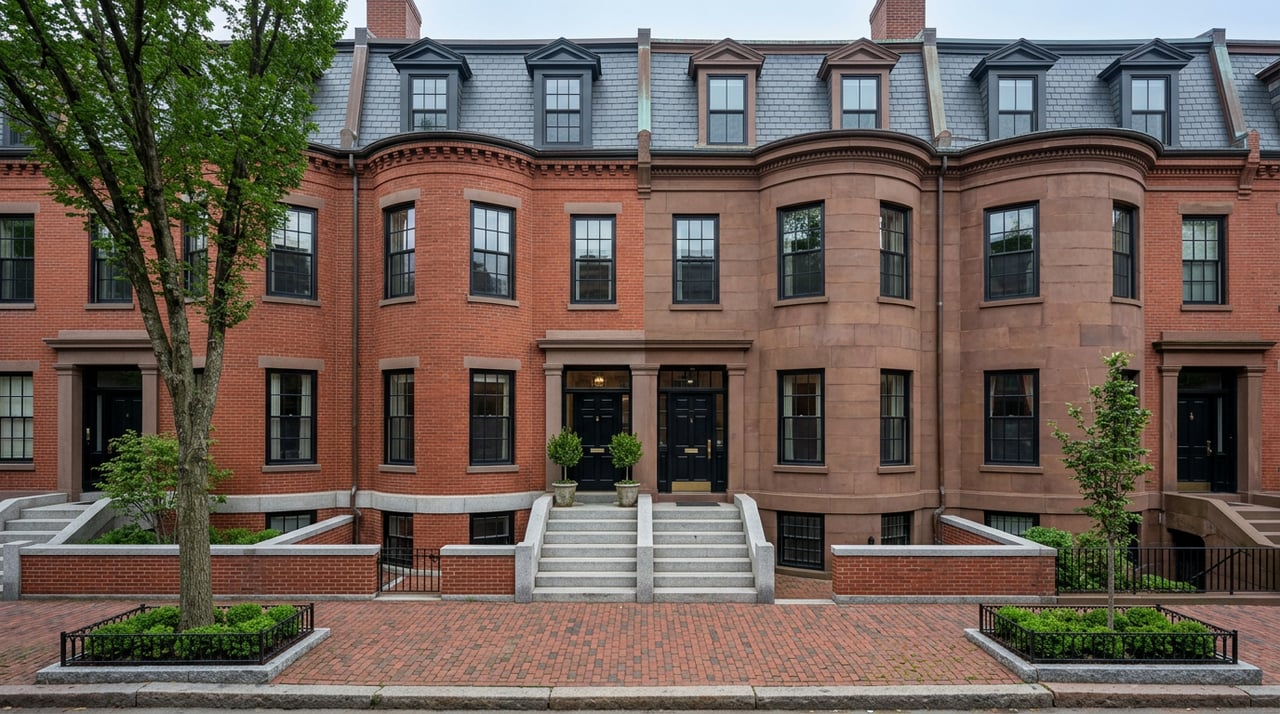
Walk Newbury Street from Berkeley to Massachusetts Avenue this month and count the doors. The number will match what you counted in January. No scaffolding has claimed a fresh lot, no rowbuilding has come down, and the eight blocks that make up Boston's most photographed shopping stretch still open onto the same nineteenth-century facades they always have. And yet more square footage of restaurant, entertainment, and retail space has landed in Back Bay this year than in almost any recent one residents can remember. Both things are true at once, and the reason is worth understanding if you live here and have been wondering why the neighborhood feels busier without feeling bigger.
Back Bay was platted on narrow, fixed lots more than a century ago, and there is no lateral room left to expand. A suburban strip can bolt on a new wing when a tenant needs more space. Back Bay can't. So when operators want more square footage this year, they go up, they go back, or they go into a building that's been sitting half-used since before the pandemic. That's the pattern behind almost everything new to eat, play, and wander into around here this fall.
Two Restaurants, One Building, Different Floors
The clearest example sits at the head of Boylston Street, where developer Samuels completed Lyrik, a mixed-use project offering more than 480,000 square feet that was built specifically to knit the neighborhood back together across the scar left by I-90 construction decades ago. Lyrik didn't just bring in office tenants like CarGurus and the Lego Group. It stacked two of the year's most talked-about restaurant openings inside the same structure.
On the ground floor at 400 Newbury, Rosa y Marigold opened in mid-April as the biggest project yet from JuanMa Calderón and Maria Rondeau, the pair behind Celeste in Somerville and La Royal in Cambridge. The 100-seat room serves Peruvian sánguches at lunch, ceviches and whole fried branzino at dinner, and live jazz on Wednesday nights and Sunday brunch. One floor up, Avra Estiatorio opened its first Boston location the same season, a 250-seat Greek seafood house with a fish market display where whole catches are laid out on ice and grilled to order. It's the New York-based brand's eighth location and its first anywhere in New England.
Neither restaurant needed a separate address on a separate block. They needed two floors of one building that already existed.
A Golf Course That Didn't Require a New Storefront
A few blocks over, the same logic shows up in a very different business. Swingers, the London-born "crazy golf and carnival" brand, opened its first New England location at 777 Boylston Street in February, and the space tells the same story as Lyrik from the opposite direction. What had been a single ground-floor retail storefront is now a two-level venue spanning more than 20,000 square feet, with two custom mini golf courses, a Belle Époque-style arcade called Carnival, and multiple cocktail bars built into the existing brick-and-timber shell rather than a new construction.
"Opening in Boston marks an exciting new chapter for Swingers," said Jeremy Simmonds, the company's co-founder and CEO.
The ownership behind that project is worth noting for anyone who's watched Boylston Street for a while. Swingers partnered with Tavistock Restaurant Collection, the group that already runs two Back Bay institutions, Abe & Louie's and Atlantic Fish Company. A related Tavistock entity owns the 777 Boylston building outright. That's not a chain parachuting into an empty box. It's an existing Back Bay operator putting more of its own building to work, going up and in rather than looking for space somewhere else in the city.
The Room That's Been Dark Since 2020
The most visible version of this pattern is also the slowest-moving one. The Bristol Lounge at the Four Seasons on Boylston Street closed during the pandemic in March 2020 and has sat empty ever since, a gap of roughly six years in a spot that was once Boston's unofficial living room for power lunches and Sunday brunch. That's about to change. A Street Hospitality, the team behind La Padrona, Trade, and Porto, is building a new restaurant and bar inside that same footprint, with James Beard Award-winning chef Jody Adams designing a menu of Dover sole, prime rib, caviar and blini, and local oysters. The finished space is planned to seat around 300 for the restaurant and bar, with a 400-member private club built into the same envelope.
The team hasn't named the project yet and isn't targeting an opening before late 2026 or early 2027, but CEO Eric Papachristos has said the name will be chosen carefully, describing it as one that
"carries a quiet nod to the heritage of the Back Bay and its classical beginnings."
What matters for anyone walking past 200 Boylston this fall is that Boston's longest-vacant Back Bay dining room isn't getting torn down or replaced with something new. It's getting refilled.
Two Sundays Left Without Cars on Newbury
If restaurants and entertainment venues are solving the no-room-to-expand problem by building upward, the city has been solving a related problem, too narrow sidewalks, by reclaiming the street itself. Open Newbury Street closes the roadway from Berkeley Street to Massachusetts Avenue to vehicle traffic on select Sundays from 10 a.m. to 6 p.m., letting pedestrians use the full width of the block instead of squeezing along the curb. The city's schedule for 2026 runs through the fall, and as of this week, two Sundays remain in the regular season:
- September 20
- October 11
A Holiday Stroll date is expected to follow in December, continuing a tradition the city piloted in 2024. If you've been meaning to walk the middle of Newbury Street without dodging traffic at Fairfield, Gloucester, or Hereford, these are the last chances before winter.
The Market That Outlasts Both of Those Sundays
While Open Newbury wraps up in the fall, the Copley Square Farmers Market keeps going a little longer. Boston's largest farmers market runs Tuesdays and Fridays through November 24 at the newly renovated McKim Plaza in front of the Boston Public Library's central branch, with more than three dozen Massachusetts vendors rotating through. Regulars like Kimball Fruit Farm and Red's Best are joined this season by newer additions including Lakon Paris Patisserie. Like Open Newbury, it's another case of Back Bay adding public life to a space that was already there rather than building something new to hold it.
What to Actually Expect From Back Bay Right Now
None of this shows up if you're watching for cranes. There isn't a single new building rising in Back Bay this fall that accounts for the restaurants, the golf course, the reopening hotel dining room, or the market crowds filling McKim Plaza twice a week. What's changed is what's happening inside and on top of what was already standing, and inside what the city already owns in the form of its own streets and plazas.
For residents, that's a useful lens for reading the neighborhood going forward. The next wave of Back Bay news probably won't come with an address you don't recognize. It'll come with a floor number, a formerly single-story shell, or a room that's been dark for years finally turning its lights back on.
If you're curious what any of this means for property in the neighborhood, from a rowhouse near Commonwealth Avenue to a condo above one of these very storefronts, the team at Donnelly + Co knows Back Bay block by block. Contact us anytime to talk through what you're seeing on the ground.